Page 1 of 1
Pillsbury Gave His M for an O....
Posted: Fri May 22, 2020 12:37 pm
by Geoff Chandler
This 1910 'Boys Own'
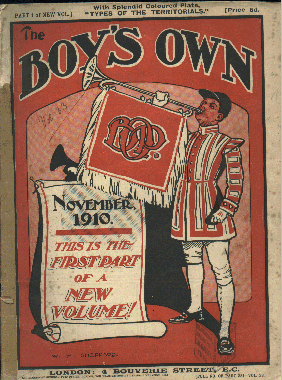
had an advert on the back cover...
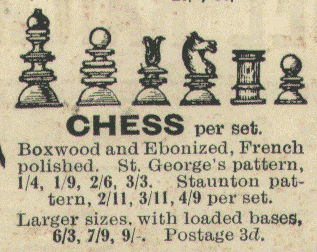
...but the intriguing bit was a chess section with a strange chess notation.(page 30)
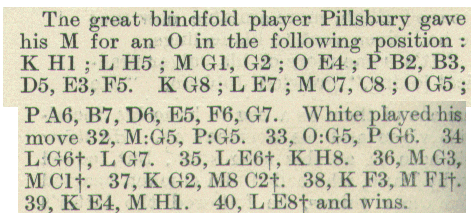
Despite the mention of 'blindfold' it is from game 3, Pillsbury - Jackson Whipps Showalter, USA Ch. 1897.
The position quoted is this (White to play move 32)
Full game:
Re: Pillsbury Gave His M for an O....
Posted: Fri May 22, 2020 12:54 pm
by John McKenna
K=King
L=Queen
M=Rook
N=Bishop?
O=kNight
P=Pawn
Amazing what Geoff finds in his old crop of curiosities.
Re: Pillsbury Gave His M for an O....
Posted: Fri May 22, 2020 1:30 pm
by Roger de Coverly
John McKenna wrote: ↑Fri May 22, 2020 12:54 pm
Amazing what Geoff finds in his old crop of curiosities.
Stamma notation one might suspect. It's an old form of algebraic.
https://en.wikipedia.org/wiki/Algebraic ... on_(chess)
Algebraic notation exists in various forms and languages and is based on a system developed by Philipp Stamma. Stamma used the modern names of the squares, but he used p for pawn moves and the original file of a piece (a through h) instead of the initial letter of the piece name.
https://en.wikipedia.org/wiki/Philipp_Stamma
Stamma's book introduced algebraic chess notation in an almost fully developed form before the now obsolete descriptive chess notation evolved. Philidor's writings had more influence after his victory over Stamma, and the descriptive system based on Philidor's approach was dominant for a long time.
Re: Pillsbury Gave His M for an O....
Posted: Fri May 22, 2020 4:04 pm
by John McKenna
Hurrah for Stamma!
Who saved us from -
"The following example with its explanation is from Nouvelle notation pour les parties ou les coups d'echecs (1836) - f:4R':r'=r 'le Pion du Fou du Roi faisant un pas à la 4. case du Roi adverse, prendre le Pion du Roi adverse et devient Pion du Roi'" (Oxford Companion)
It should be added that although the 2nd edition (1st edition Paris, 1737) of Stamma's The Noble Game of Chess was published in London in 1745 his particular form of algebraic notation "was called German notation and not well received in England. In 1818 Lewis said that it was 'generally considered so tedious and fatiguing...'" (Oxford Companion)
The form of notation in Geoff's original post is also there in the Oxford Companion -
"In Complete Guide to the Game of Chess H.L.F. Meyer (1839-1928) introduced his 'Universal Notation' designating the pieces by the letters K to P, the book failed to sell. (Meyer, a passionate non-smoker, cancelled his subscription to a chess magazine because it published an illustration of a player who happened to have a pipe in his mouth.)
I like that "who happened to have a pipe..."
Now Geoff will be on the lookout for copies of Meyer's and Stamma's books or, better still, knocking up contemporary "antique" versions.
Re: Pillsbury Gave His M for an O....
Posted: Fri May 22, 2020 5:32 pm
by JustinHorton
John McKenna wrote: ↑Fri May 22, 2020 4:04 pm
Meyer, a passionate non-smoker, cancelled his subscription to a chess magazine
Which one
Re: Pillsbury Gave His M for an O....
Posted: Fri May 22, 2020 6:28 pm
by John McKenna
It does not specify in my edition of the Companion.
Hooper & Whyld could not tell all in such an encyclopedic work but they must have had their sources.
Tim Harding might come on with an inkling, perhaps.
Re: Pillsbury Gave His M for an O....
Posted: Sun May 24, 2020 4:03 pm
by James Pratt
'Rabbit's Review' ?
Re: Pillsbury Gave His M for an O....
Posted: Tue May 26, 2020 5:28 pm
by JustinHorton
John McKenna wrote: ↑Fri May 22, 2020 4:04 pm
The form of notation in Geoff's original post is also there in the Oxford Companion -
"In
Complete Guide to the Game of Chess H.L.F. Meyer (1839-1928) introduced his 'Universal Notation' designating the pieces by the letters K to P, the book failed to sell. (Meyer, a passionate non-smoker, cancelled his subscription to a chess magazine because it published an illustration of a player who happened to have a pipe in his mouth.)
Oh, I hadn't remembered I actually have a copy of
The Oxford Companion, but as you say, it is not forthcoming on the source of its story.
Re: Pillsbury Gave His M for an O....
Posted: Tue May 26, 2020 5:42 pm
by John McKenna
James Pratt wrote: ↑Sun May 24, 2020 4:03 pm
'Rabbit's Review' ?
Perhaps Jas. P knows something more?
I am more into John Updike's
Rabbit (on the wireless.)
Re: Pillsbury Gave His M for an O....
Posted: Tue Jun 02, 2020 12:06 pm
by Kevin Thurlow
I was looking at an obituary in
http://www.mccu.org.uk/mgame/mg15.pdf and decided to read the rest of the issue, when I spotted on page 10, a piece about notation...
Re: Pillsbury Gave His M for an O....
Posted: Tue Jun 02, 2020 12:56 pm
by John McKenna
From which -
Clearly, however, Philidor’s way of recording moves had to be made more efficient if English chess literature were to have room to grow. A major innovation in that respect occurred in 1817, when an edition of Philidor’s works introduced a system of abbreviations into Philidor’s ponderous notation. Those abbreviations, by the way, were introduced rather timidly with suitable apologies to the reader. Over the next few decades, more use of abbreviations occurred, and the descriptive notation of modern times slowly took shape...
We have come a long way from “ the white King commands his owne knight into the third house before His owne Bishop" to the simple "Nf3," and chess literature has come a long way as well!
NB: An edition of Philidor's
Analysis of the Game of Chess published 1819, in London, gives (Ngf3 as) -
King's knight to his bishop's third square.
And so was still not descriptive notation, but it was on its way to KKt-KB3.