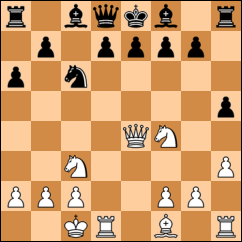
Hi Warren.
I think your sentence should read.
"Richard Palliser does
NOT give e5 any notes?
Sorry if the correction is wrong. I myself sigh with pity at these pendantic
glums who feel the need to correct spelling and grammar on public forums.
Here however missing out the 'Not' is or was, slightly confusing. (to me anyway).
Roger is on the money when he says no previous games in theory.
An opening book cannot cover every eventuality and plausible moves with
no game history means work for the author (hence no notes)

.
The object of the opening book is to relieve you of money by giving
you a collection of games (which you could download yourself from any
reasonable database). Tart it up with a few Fritz notes and Ker-Ching!
So you are looking at Closed Sicilian lines from a Black point of view.
We again heed Roger's words.
"...you reach a position which appears unknown to theory."
Listen to what good players say, you get that advise for free and it is often good.
What they say and what they write sometimes differ.
(always remember Warren......Ker-Ching!)
So there is very strong chance you are wasting your time looking at an opening
position that you will never see OTB.
Forums all over the net are filled with questions about unmentioned and
unplayed but yet totally plausible moves in the opening.
As I said. "An opening book cannot cover every eventuality...."
Selecting what opening variations to look at is a skill.
The skill is getting into a postion
you like and feel
you can play.
Always remembering of course that your opponent (damn them) is
trying to do the same.
The other part of the skill is deciding how much time (and memory cells) are you
going to spend on a variation (which in this case history dictates you will never see OTB).
However you asked and I like talking chess.
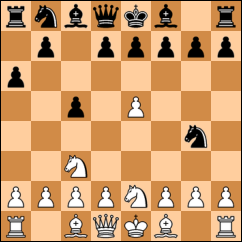
Now I differ from Roger (and from the one game I found with this line).
I would never ever play 5.f4 in that position.
(I'd also never see this postion. 3.Nge2?? that is not a me move, it's crap).
Playing f4 to hold a pawn on e5 in the opening without a 100% plus.
No way. I'd sooner let the thing go.
(toss that opening book behind the settee and get yourself Rowson's Zebras and you
will learn all about the trigger happy f-pawns and a lot lot more about the game.)
5.d4 .....
I like anti-Sicilians as White but always look for a chance to transpose
into an open game with d4 if
I want to.
It's important that bit. 'If I want to....'
It's postions
you like. Not what opening books tell you to like.
(Yes listen to the good guys, but you must know yourself.)
5.....cxd5
6. Qxd4 ....
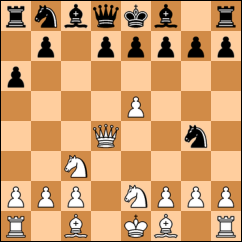
That will do. I'll play that.
I've lost my White plus so I'll pretend I started with Black.
I'm not at all happy about the thing on e2
but I won't worry about it because it will never happen in one of my games.
Here is the one game I found with this line.
Again we fall back on Roger's words.
"A Black knight can take up residence on the f5 square...."
Listen to the good guys....
In the game the Knight threatened to come to f5 so White played g4.
(This is all explained in Zebra's how f4's and Black's f5's lead to other weakening pawn moves.)
White ended up all cramped and felt the need to play 14.Kd2 in this postion
to get himself sorted out.
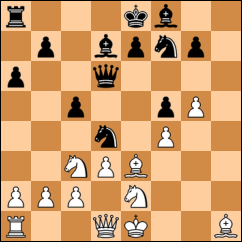
Hope this helps. I enjoyed doing it.
Geoff
Afek,Y (2314) - Kodentsov,G (2279) Gronigen 2009
1.e4 c5 2.Nc3 a6 3.Nge2 Nf6 4.e5 Ng4 5.f4 d6 6.h3 Nh6 7.exd6 Qxd6 8.g4 f5 9.g5 Nf7 10.Bg2 h6 11.h4 hxg5 12.hxg5 Rxh1+ 13.Bxh1 Nc6 14.d3 Bd7 15.Be3 Nd4 16.Kd2 0-0-0 17.Qg1 Nxe2 18.Nxe2 e6 19.a4 Bc6 20.Ra3 c4 21.Rc3 Bxh1 22.Qxh1 Qd5 23.Qxd5 exd5 24.dxc4 d4 25.Nxd4 Bb4 26.Kd3 Bxc3 27.Kxc3 g6 28.c5 Re8 29.Bd2 Nd8 30.Nf3 Nc6 31.b4 Re4 32.Nh4 Ne7 33.Kd3 a5 34.bxa5 Rxa4 35.c4 Kd7 36.Bc3 Ke6 37.Bf6 Ra3+ 38.Kc2 Rh3 39.Bxe7 Rxh4 40.Bd6 Rh3 41.Be5 Kd7 42.Bd6 Kc6 43.Kb2 Rf3 44.Kc2 Ra3 45.Kb2 Rxa5 46.Kc3 Ra1 47.Kd4 Re1 0-1