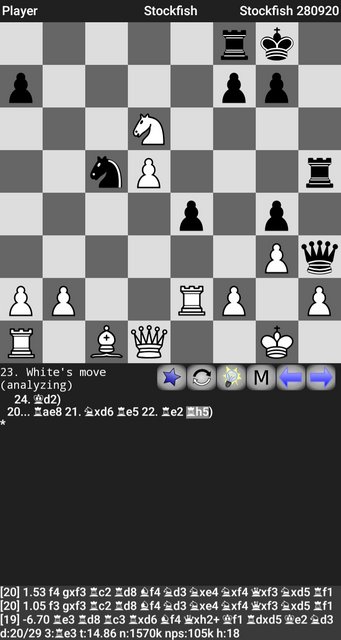
I've seen similar instances of this before, involving transpositions, but their occurring in this way makes it particularly easy to illustrate.
Why does this happen?

However, in fact Stockfish is using a lot of forward pruning, reduction and extension techniques that are state/history dependent, so the results of the search of a subtree depends on the state/history with which it entered the subtree. Therefore, starting with hash table entries that influence move ordering (and can actually return a different evaluation than searching the subtree again) leads to a different result of for a search of same depth.
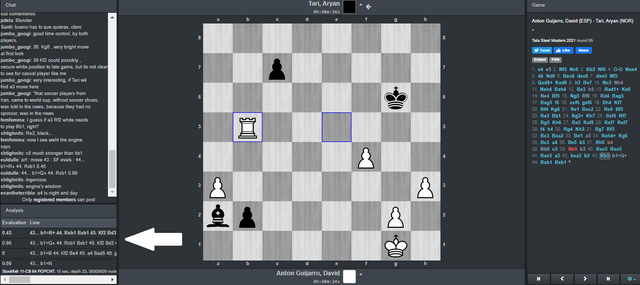
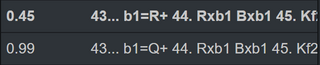
If evidence of the Ken Regan and similar programs was ever to be subjected to a determined attempt in a court of law to discredit it, this inconsistency of evaluations would be a weakness.JustinHorton wrote: ↑Mon Jan 04, 2021 1:47 pmI've seen similar instances of this before, involving transpositions, but their occurring in this way makes it particularly easy to illustrate.
I noticed this effect about 9 years ago when analysing positions and concluded that it was due to entries in the hash table potentially being different when the program starts its next block of analysis. I came across it because it was possible to improve the depth of analysis and performance by forcing the beast down the lines you intuitively felt were best then backtracking one move at a time. This forced subsequent analysis to include the line you have selected which was still in the hash table.The end result was that your best guess would be checked out against new computer selected lines and you would sometimes be correct!Roger de Coverly wrote: ↑Thu Jan 21, 2021 6:06 pmIf evidence of the Ken Regan and similar programs was ever to be subjected to a determined attempt in a court of law to discredit it, this inconsistency of evaluations would be a weakness.JustinHorton wrote: ↑Mon Jan 04, 2021 1:47 pmI've seen similar instances of this before, involving transpositions, but their occurring in this way makes it particularly easy to illustrate.
So, in less than 50 minutes it's gone from speculation to conjecture - not bad but still not enough to settle anything.E Michael White wrote: ↑Thu Jan 21, 2021 6:55 pmI noticed this effect about 9 years ago when analysing positions and concluded that it was due to entries in the hash table potentially being different when the program starts its next block of analysis. I came across it because it was possible to improve the depth of analysis and performance by forcing the beast down the lines you intuitively felt were best then backtracking one move at a time. This forced subsequent analysis to include the line you have selected which was still in the hash table.The end result was that your best guess would be checked out against new computer selected lines and you would sometimes be correct!Roger de Coverly wrote: ↑Thu Jan 21, 2021 6:06 pmIf evidence of the Ken Regan and similar programs was ever to be subjected to a determined attempt in a court of law to discredit it, this inconsistency of evaluations would be a weakness.JustinHorton wrote: ↑Mon Jan 04, 2021 1:47 pmI've seen similar instances of this before, involving transpositions, but their occurring in this way makes it particularly easy to illustrate.
I would expect this to be more of an issue recently with the advent of SSD discs and ensuring files needing fast access are stored there. The suggestion, that machine type and size in the cheating thread are irrelevant, is in my view probably misguided.
These are more things that Ken R needs to consider but as he is fundamentally a Computer Science Prof rather than a statistician I expect he can resolve them.

Who has claimed that it is?John McKenna wrote: ↑Thu Jan 21, 2021 6:50 pmWhatever this thread purports to be it's not "science".
Do you really not know? Nor even hazard a guess?Matt Mackenzie wrote: ↑Thu Jan 21, 2021 7:11 pmWho has claimed that it is?John McKenna wrote: ↑Thu Jan 21, 2021 6:50 pmWhatever this thread purports to be it's not "science".